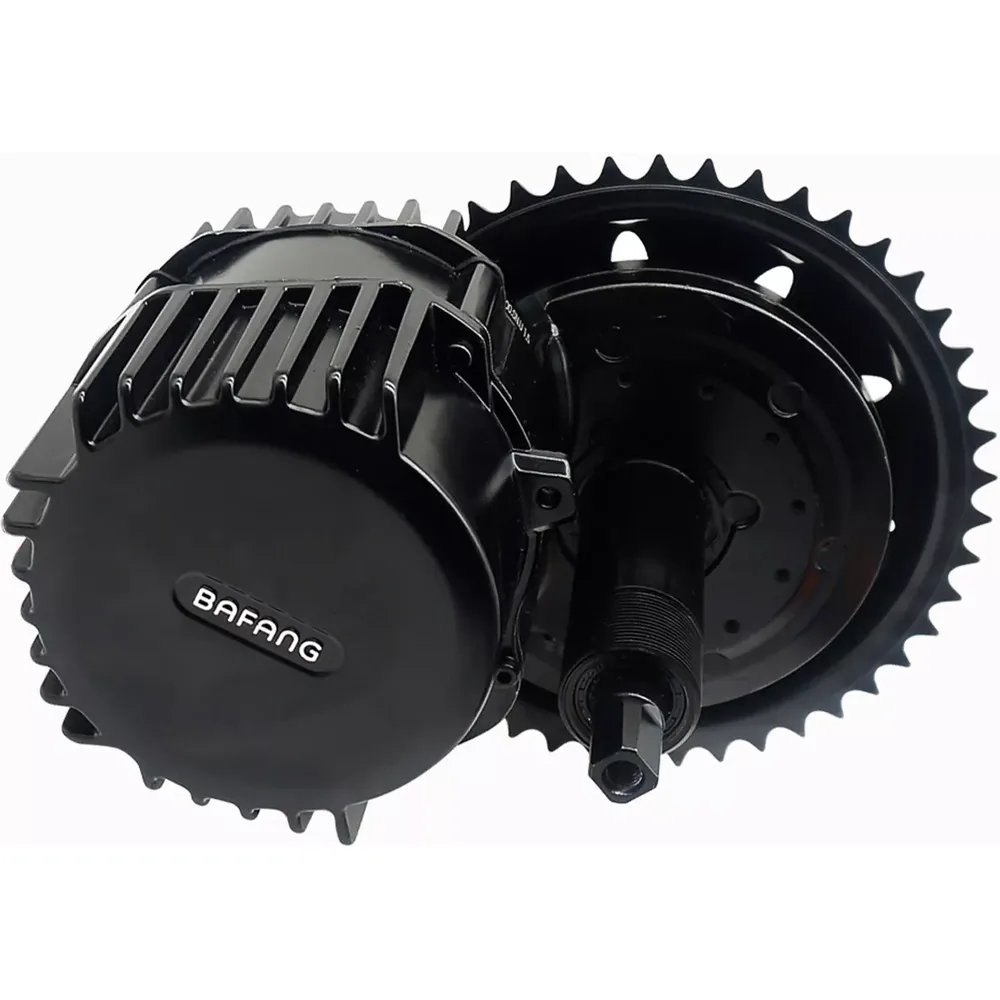
Bafang or Tongsheng: cadence versus torque
| Rating | Produit | Prix | |
|---|---|---|---|
| 8.8/10 | 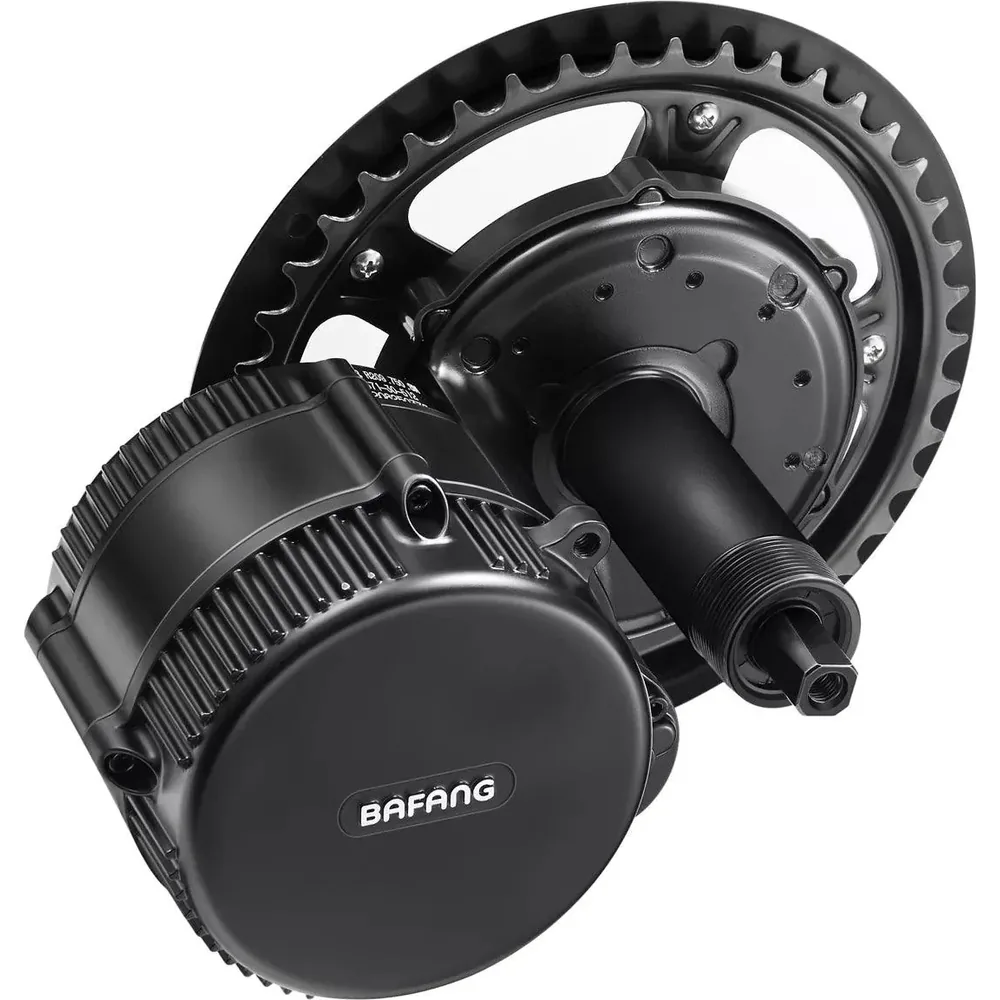 Bafang BBS02BBafang Bafang BBS02BBafang | 549 € | |
| 8.2/10 | 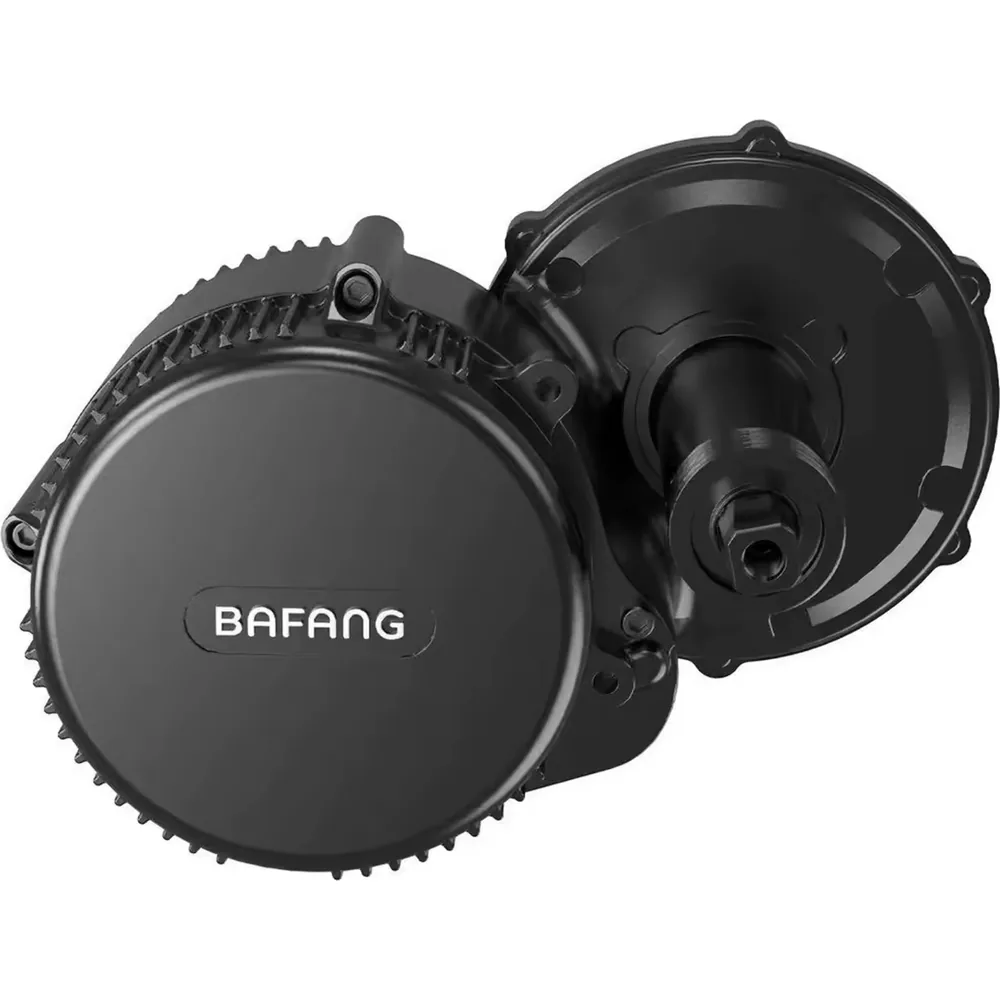 Bafang BBS01BBafang Bafang BBS01BBafang | 449 € |
The debate between Bafang and Tongsheng rarely plays out on watts. Both manufacturers offer mid-drive motors of comparable power; what sets them apart in daily use is how the motor decides to help. On one side, crank rotation; on the other, force applied to the pedals. Everything else — claimed torque, amperage, weight — follows from that architectural choice far more than it precedes it.
This page's scope
We don't publish a Tongsheng spec sheet: our source is Bafang's manufacturer documentation, and we don't quote values we can't verify with the manufacturer. This page therefore compares two approaches — cadence sensor against torque sensor — and shows what the BBS series has to offer against each.
Two philosophies of assistance
A cadence-sensor kit, like the BBS01B, BBS02B and BBSHD, detects that the cranks are turning and applies the requested assistance level. The rider's effort doesn't enter the equation: at level 5, the motor pushes the same whether you press hard or barely pedal at all. It's a command, almost a throttle slaved to pedaling.
A torque-sensor kit measures the pressure applied to the pedals and scales its help proportionally. The bike then responds like a purely mechanical bike whose legs got stronger. This is the approach Tongsheng popularised on the conversion-kit market, and it's the one point where the two families never meet: a sensor can't be added afterwards, it's built into the motor block.
What each approach gains and loses
| Cadence sensor | Torque sensor | |
|---|---|---|
| Natural pedaling, fine dosing | — | ✓ |
| Moving forward without effort, heavy load | ✓ | — |
| Spares the chain and cassette | — | ✓ |
| Simple level-based setting | ✓ | — |
| Immediate pull off the line | ✓ | — |
| Consumption tied to effort supplied | — | ✓ |
Neither column is better in the absolute. A rider who wants to recover their own feel with discreet help looks for the second; a courier climbing a hill with 40 kg on the back rack wants the first. The honest question isn't "which sensor is better", but "who should supply the effort on my route".
What the BBS series offers against each need
You want to move forward without effort
This is the ground on which the cadence sensor wins, and the BBS series answers with torque. The BBS02B is its most versatile representative: 120 Nm, 25 A, an install on a threaded shell of 68 to 73 mm. Its full review is in our Bafang BBS02B review. For a heavier load or a longer climb, the BBSHD pushes the same logic one step further.
You want the assistance to follow your legs
None of the three kits covered here does that: they all run on cadence. If this criterion is decisive for you, the comparison plays out outside the BBS series, and it's better to accept that than to hope for a setting that doesn't exist. Cadence sensor or torque sensor details precisely what each feels like, from a standing start to a climb.
You want to spare your drivetrain
Structural advantage to the torque sensor, whose assistance naturally drops off as pedal pressure decreases — which is exactly when you shift gears. On a cadence kit, the fix exists and costs little: a gear-shift sensor, which cuts assistance for the duration of the shift. Its installation is described in the Bafang kit installation guide.
Three questions to ask before deciding
Does your bike need to stay a bicycle?
A kit of 500 W or more, whatever the brand, falls outside the pedelec framework. The topic is covered in 250 W or 750 W, what the regulation says.
Who supplies the effort?
With a torque sensor, assistance follows your legs. If the goal is precisely to avoid straining, that behaviour works against you.
What drivetrain can take the torque?
Proportional assistance wears the chain less than all-or-nothing assistance. On a bike whose drivetrain is already tired, that weighs in the calculation.
Our position
Bafang BBS02B
If fitting your current bike is a condition, the sensor question closes itself: the BBS series runs on cadence, and the BBS02B is its best compromise.
549 €
One last, often decisive point: parts availability. The BBS series benefits from a very wide ecosystem — displays, chainrings, controllers, tutorials — which keeps a repair simple to document and cheap. It's a criterion spec comparisons ignore, and one that comes back to mind after two winters. It weighs into our ranking of the three Bafang kits.
FAQ
Why don’t you publish a spec sheet for Tongsheng motors?
Our source is Bafang’s manufacturer documentation. The Tongsheng figures in circulation vary by version and retailer, and we haven’t collected them at the source: reproducing them here would give them a credit they don’t have on this site.
Is a torque-sensor kit always preferable?
No. It gives a more natural pedaling feel and spares the drivetrain, but it asks the rider to supply an effort proportional to the assistance. To carry a heavy load uphill without straining, a cadence sensor paired with high torque remains more effective.
Does a torque-sensor Bafang kit exist?
Not in the BBS series, the range of conversion kits this site covers: the BBS01B, BBS02B and BBSHD all run on a cadence sensor. If a torque sensor is your deciding factor, the comparison has to happen outside this range.